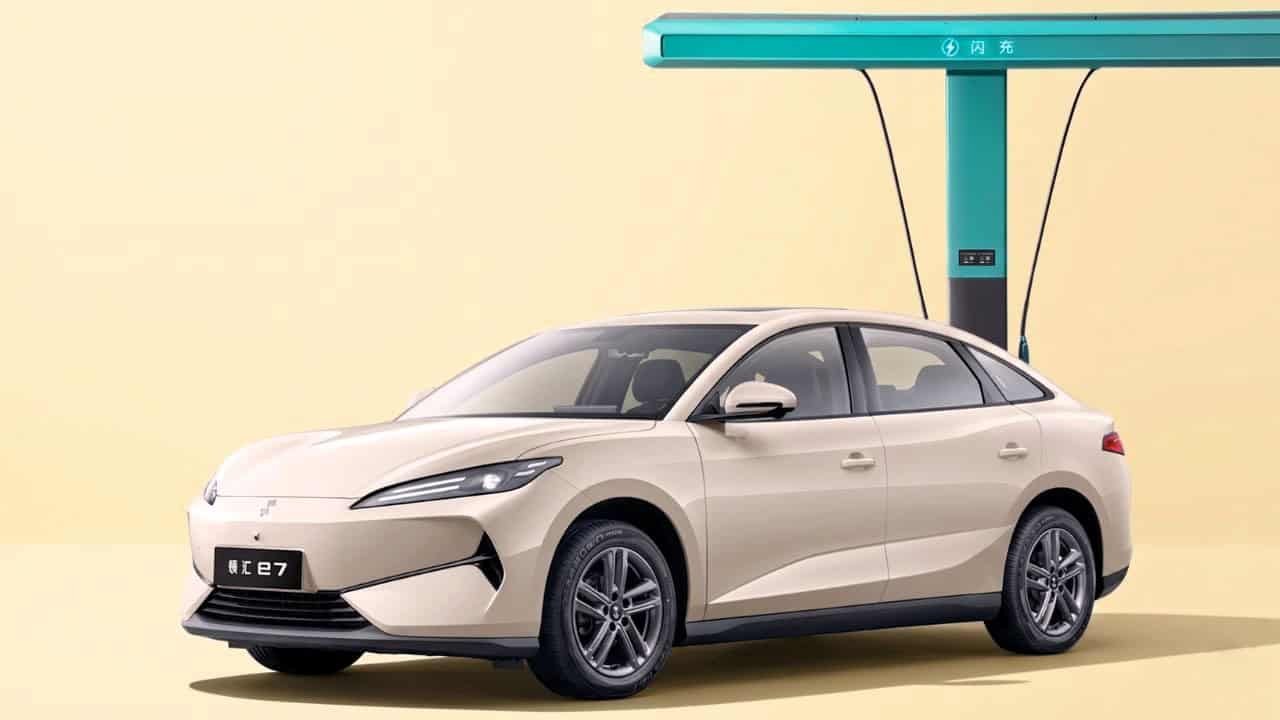

In a market flooded with electric sedans promising efficiency and range, one new entrant is quietly rewriting the rulebook. Chinese EV giant BYD has unveiled the Linghui e7, and it’s not just another affordable electric car—it’s a bold attempt to eliminate one of EV ownership’s biggest pain points: charging time.
Launched under BYD’s newly created Linghui Auto sub-brand, the e7 combines ultra-fast charging, practical design, and aggressive pricing into a package that could disrupt both the private car market and the booming ride-hailing ecosystem.
A New Sub-Brand With a Clear Mission
The Linghui e7 marks the first product from BYD’s dedicated commercial mobility arm, Linghui Auto, introduced earlier in 2026. Unlike the brand’s more premium passenger offerings, this division is laser-focused on high-usage vehicles—especially those operating in ride-hailing fleets.
It’s a calculated move. By separating its commercial lineup, BYD protects the premium image of its mainstream vehicles while aggressively targeting China’s massive ride-hailing economy.
Shockingly Affordable, Surprisingly Capable
The Linghui e7 is priced between 95,800 and 115,800 yuan (roughly $14,000–$17,000), making it one of the most accessible mid-size electric sedans on the market today.

Buyers can choose from five variants, with entry-level models offering a 450 km range, while higher trims stretch up to 550 km (CLTC). Even when adjusted to stricter global testing standards, the real-world range remains competitive for its class.
But the real headline isn’t the price—or even the range.
5-Minute Charging That Feels Unreal
The Linghui e7’s standout feature is its flash-charging capability, powered by BYD’s second-generation Blade Battery.
In practical terms:
- 10% to 70% charge in just 5 minutes
- Up to 97% charge in under 9 minutes
That’s not a marginal improvement—it’s a paradigm shift. For ride-hailing drivers, this could mean grabbing a quick charge between trips instead of waiting nearly an hour at a station.
Even in extreme cold conditions as low as -30°C, charging times increase only slightly. That level of consistency hints at serious advancements in battery thermal management.
Battery Tech That Prioritizes Safety
Speed often raises concerns about safety—but BYD seems to have tackled that head-on.
The Blade Battery used in the e7 has undergone:
- 500-cycle high-speed charging stress tests
- Nail penetration tests without thermal runaway
- Multi-cell short-circuit simulations
These results place it ahead of many current safety benchmarks, reinforcing BYD’s reputation for robust battery engineering.
Built to Handle the Grind
Unlike typical consumer EVs, the Linghui e7 is engineered for endurance.
- Designed lifespan: up to 600,000 km or 6 years
- Reinforced chassis tested over thousands of rough-road cycles
- Practical tweaks like a repositioned charging port for faster access during frequent stops
This is a car built not just to impress—but to survive relentless daily use.
Spacious, Minimalist, and Surprisingly Smart
Dimensionally, the e7 sits firmly in the mid-size category, measuring 4,780 mm in length with a 2,820 mm wheelbase. The result is a roomy cabin, especially in the rear, where a flat floor improves passenger comfort—a key factor for ride-hailing ratings.

Inside, the design leans toward clean minimalism:
- Large 15.6-inch infotainment display
- Wireless charging pad
- Column-mounted gear selector for added space
The system also supports multi-zone voice commands, allowing passengers and driver to interact with the car simultaneously—an unusual but practical touch.
Charging Network Growing at Breakneck Speed
A fast-charging EV is only as useful as the network supporting it—and BYD seems well aware.
The company has already deployed over 4,000–5,000 flash-charging stations across China and is aiming for 20,000 stations by the end of 2026. Partnerships with ride-hailing giant Didi are further accelerating adoption.

There’s even a unique initiative where new stations can be installed within a week if just a handful of users request it.
A Serious Threat to Traditional Sedans
The Linghui e7 doesn’t just compete with electric cars—it challenges conventional petrol sedans as well. With lower running costs, near-instant charging, and a comfortable ride, it positions itself as a viable alternative to everyday vehicles like compact sedans used in fleets worldwide.
And with incentives like free charging benefits for early buyers, the deal becomes even harder to ignore.
The Bigger Picture
The arrival of the Linghui e7 signals something larger than just a new model launch. It represents a shift in how electric vehicles are perceived—especially in high-utilization scenarios like ride-hailing.
If BYD’s flash-charging technology scales successfully, it could erase one of the last major barriers to EV adoption.
The real question now is simple:
Will this ultra-affordable, ultra-fast-charging sedan remain a fleet-focused workhorse—or will everyday buyers start lining up for it too?
Either way, the Linghui e7 has already made one thing clear—the future of EV charging might arrive much sooner than expected.
For more information about the BYD Linghui e7, please visit CarNewsChina.
👉 Please 📩SUBSCRIBE to us for more real-world EV analysis, news, and deep dives — written for EV fans by EV fans.

Hey, I’m Badal! I’m super passionate about cars—especially electric ones. Whether it’s EVs, electric trucks, bikes, or anything with a battery and wheels, I’m all in. I love writing blogs and articles that break things down for fellow enthusiasts and curious readers alike. Hope you enjoy the ride as much as I do! Enjoyed reading? You can buy me a coffee on PayPal ☕ → paypal.me/BadalBanjare