
In a story that feels almost too bizarre to be real, a YouTuber has taken a broken, stripped-down Tesla Model 3 and transformed it into something wildly unconventional—a raw, open-air electric “go-kart” that still delivers over 200 miles of range. It sounds absurd. Yet, it’s very real—and it’s quickly gaining traction across the internet.
A Forgotten Tesla, Bought for the Price of a Used Bike
The saga begins with a tip-off. Sitting idle in a driveway in Idaho was a heavily dismantled 2021 Tesla Model 3—abandoned mid-project and left to decay.
The car had originally been purchased for around $6,000–$7,000 by a builder who dreamed of transplanting its electric drivetrain into a retro 1970s concept car. But that vision never materialized. The sheer workload—hundreds of hours of fabrication and bodywork—proved too daunting.
Enter YouTuber Remmy Evans.
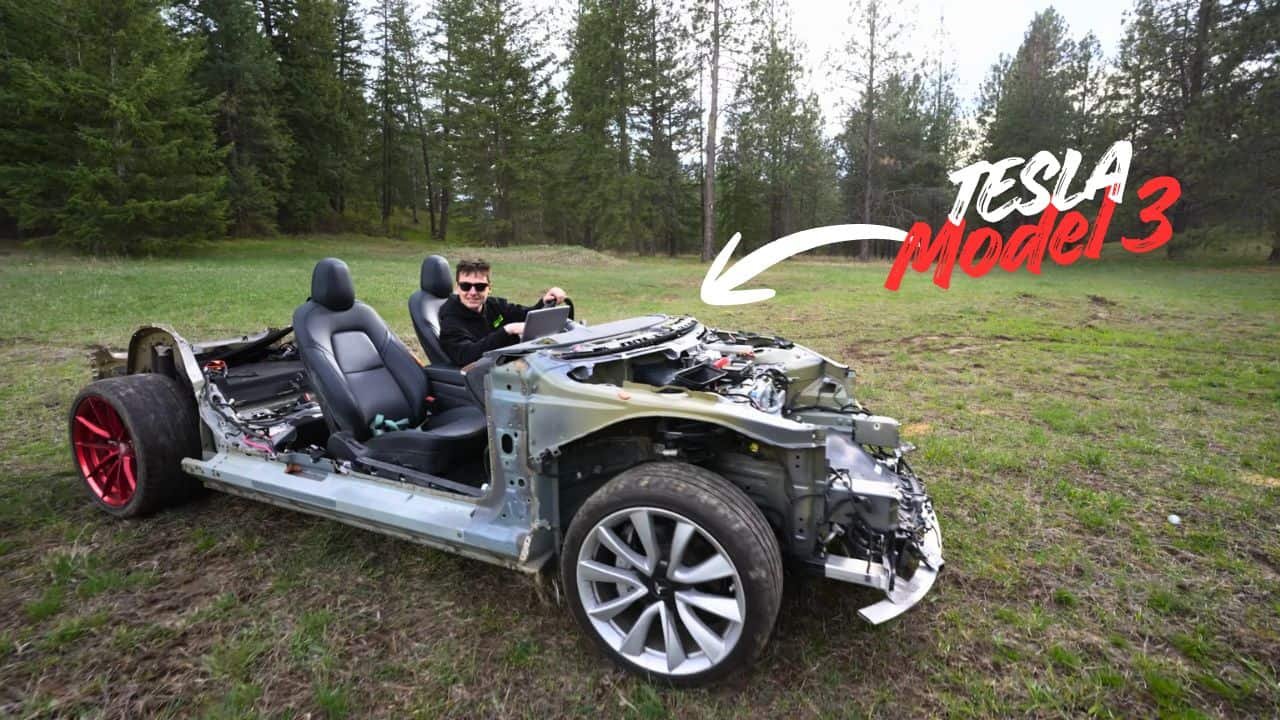
After some negotiation, he secured the vehicle for just $2,000. What he got wasn’t a car in the traditional sense. It was a rolling skeleton.
The essentials were there—battery pack, electric motors, steering, seats, and Tesla’s signature touchscreen. Everything else? Missing.
No body panels. No windshield. No glass. No safety systems.
And yet… it still worked.
The Most Shocking Detail: 212 Miles of Range
Here’s where things get truly surprising.
Despite its stripped condition and years of neglect, the Tesla powered on without hesitation. Once fully charged, the display showed an estimated 212 miles (341 km) of range.

That single figure says a lot.
It highlights something EV enthusiasts have long argued—the durability of electric drivetrains. Even when the rest of the vehicle is practically gone, the core components keep going.
78 Error Codes… and Zero Fear
Of course, this wasn’t a perfectly functioning car.
The onboard system was flooded with warnings—78 error codes, to be exact. Missing cameras, disconnected sensors, disabled safety systems—everything the software relies on was either removed or broken.
But instead of fixing those issues, Evans leaned into them.
By effectively bypassing Tesla’s electronic safeguards, the car behaved in a much more raw, unrestricted way. Traction control? Practically nonexistent. Stability systems? Gone.
The result: a machine that could drift, slide, and spin far more freely than a standard Model 3.
It wasn’t refined. It wasn’t safe. But it was undeniably thrilling.
From Scrap to Street—and Then Off-Road Madness
After replacing dangerously worn tires—some down to exposed wires—with fresh rubber, Evans decided to test his creation in the real world.
And not cautiously.
He drove it on public roads. For nearly 25 minutes. Even made a stop at a retail store.
No doors. No windshield. No seatbelts—just a ratchet strap acting as a makeshift harness.

Then came the real chaos.
On private land, the skeletal Tesla was pushed to its limits—drifting across dirt, launching over jumps, and tearing through terrain like an oversized RC car. Speeds climbed past 60 mph, with wind blasting directly into the cabin.
One passenger summed it up perfectly: it felt like a Polaris Slingshot—only faster and far more intense.
Charging Problems Lead to DIY Engineering
If driving the car was unconventional, charging it was even more so.
During an attempt to use a public fast charger, Evans discovered the adapter didn’t fit. Most people would stop there. He didn’t.
Instead, he bought cutting tools and physically modified the adapter—trimming it down until it connected. It was crude, borderline reckless, but it worked.
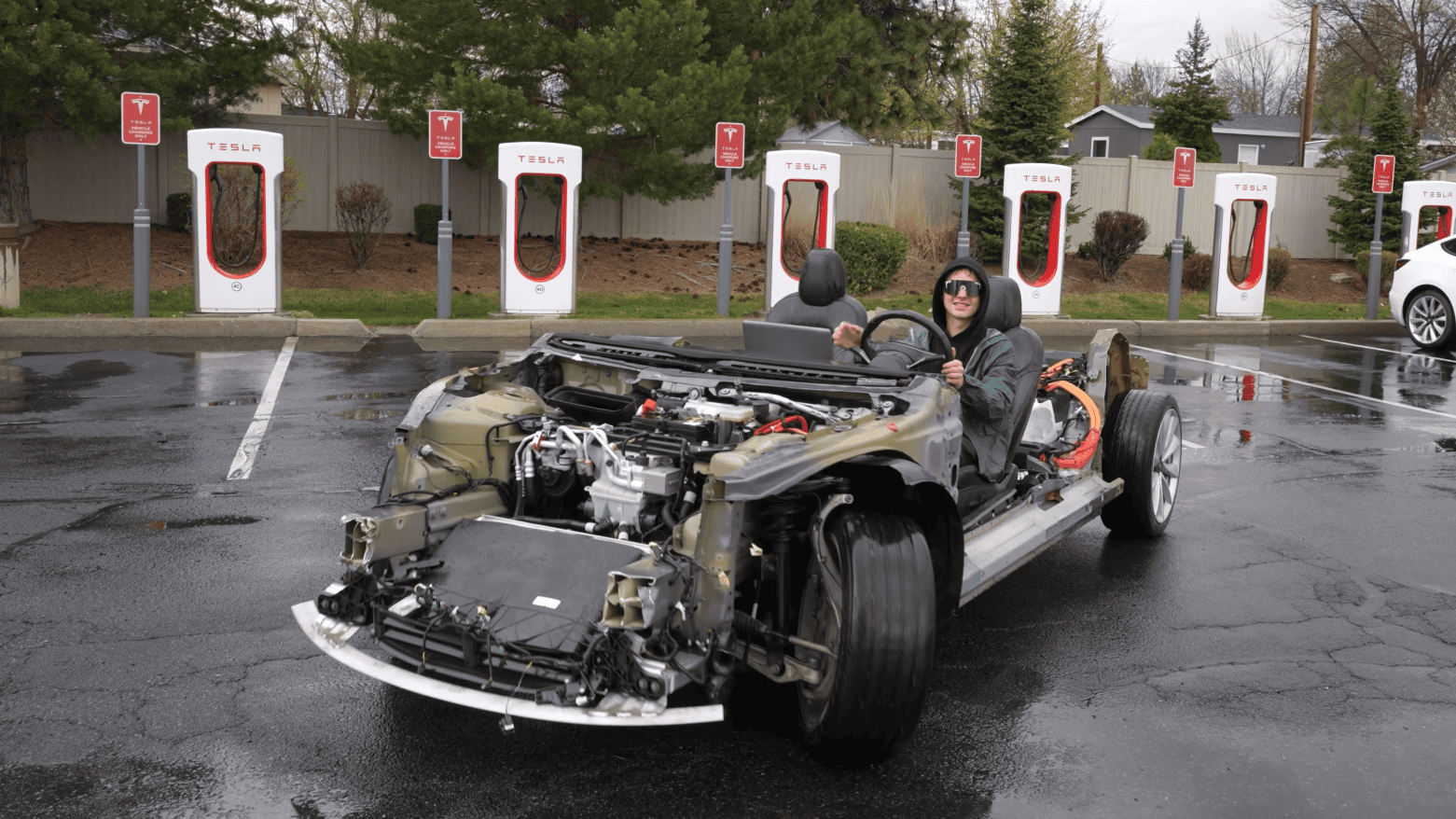
Still, limitations remained.
Without proper software support, fast charging may not function as intended. Updating the system could fix it—but that introduces a bigger risk: Tesla’s software might detect missing components and disable the car entirely.
At home, charging takes significantly longer—around 7–8 hours on Level 2 and over 14 hours on a standard outlet.
The Bigger Issue: EV Depreciation Hits Hard
Beyond the viral spectacle, this story reveals something deeper about the EV market.
Electric vehicles—especially early models—are depreciating rapidly.
Data suggests the Tesla Model 3 can lose up to 60% of its value within five years. Some variants have dropped from over $50,000 to nearly half that. While it still performs better than certain rivals, the decline is steep enough to create opportunities like this.
A functioning Tesla for $2,000? A few years ago, that would’ve sounded impossible.
Today, it’s rare—but not unthinkable.
When Software Becomes the Biggest Obstacle
As Evans continued experimenting, new problems began to emerge.
After connecting the car to Tesla’s mobile app, system warnings escalated. “Service Required” messages appeared. Functionality became unpredictable.
This highlights a unique challenge with modern EVs—software control.
Unlike traditional cars, Teslas rely heavily on integrated systems that constantly monitor hardware. Remove too many components, and the software starts pushing back. In some cases, it can limit performance—or even render the vehicle unusable.
That’s the risk Evans is now navigating.
Watch Remmy Evans’s Full Video
A Wild Experiment—With a Serious Takeaway
At first glance, this looks like pure internet chaos. A stripped Tesla doing donuts and jumps. A viral stunt built for views.
But underneath the madness lies a compelling truth.
Even in its most broken, incomplete state, the Tesla Model 3’s core—its battery and motors—remains incredibly resilient. It keeps running. Keeps delivering range. Keeps performing.
That’s the quiet takeaway from this loud, outrageous experiment.
Not the drifting. Not the DIY hacks. Not even the $2,000 price tag.
It’s the fact that the heart of an EV can survive almost anything—and still keep going.
And honestly, that might be the most fascinating part of all.
👉 Please 📩SUBSCRIBE to us for more real-world EV analysis, news, and deep dives — written for EV fans by EV fans.

Hey, I’m Badal! I’m super passionate about cars—especially electric ones. Whether it’s EVs, electric trucks, bikes, or anything with a battery and wheels, I’m all in. I love writing blogs and articles that break things down for fellow enthusiasts and curious readers alike. Hope you enjoy the ride as much as I do! Enjoyed reading? You can buy me a coffee on PayPal ☕ → paypal.me/BadalBanjare