
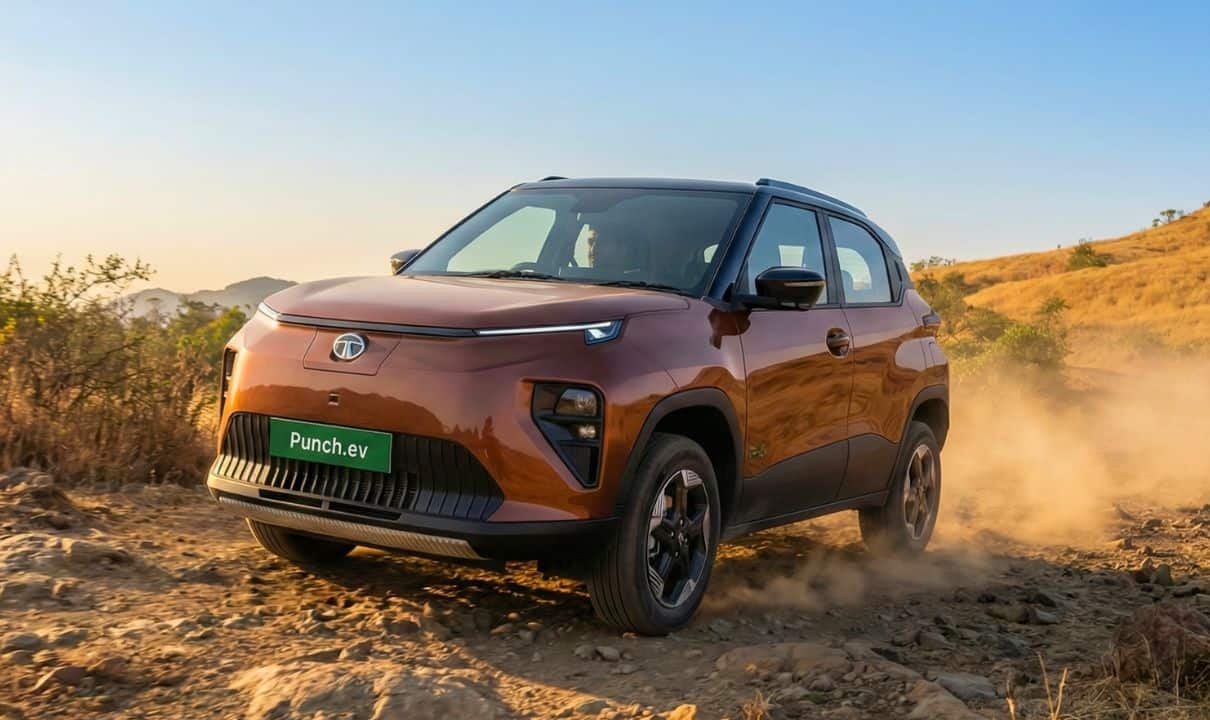

The sub-4 metre segment — long dominated by petrol hatchbacks and compact SUVs — is rapidly becoming a battleground for affordable EVs in tight city streets, Crowded parking lots, and amid rising fuel prices. The formula suddenly makes even more sense when paired with electric mobility.
And 2026 could be the year this shift accelerates.
Tata Punch EV Facelift Arriving February 20
Leading the charge is the refreshed Tata Punch EV, officially set to debut on February 20, 2026.
Ahead of its launch, the electric micro-SUV has already been spotted undisguised on public roads, revealing its production-ready styling. The updates are evolutionary rather than radical — but they’re meaningful.
Up front, the bumper has been redesigned with a cleaner, more minimalist layout. The earlier black trim connectors are gone. In their place sit a sharper air dam and a revised skid plate, giving the EV a more planted expression. The signature Y-shaped LED DRLs remain untouched, as does the centrally mounted charging flap — two visual cues that have become synonymous with the Punch EV.

The side profile stays upright and compact, though new alloy wheel designs are expected on higher trims. Fresh paint options, including brown and a bright yellow, will expand buyer choice.
At the rear, the changes are more pronounced. A full-width LED light bar now stretches across the tailgate, visually aligning it with the updated petrol Punch and lending a more premium finish.
Mechanically, Tata is expected to retain the existing 25kWh and 35kWh battery packs. The smaller unit produces 82hp and 114 N · m, offering a claimed range of 265km. The larger 35kWh version generates 122hp and 190Nm, with an ARAI-certified range of 365km.
However, industry chatter suggests Tata could introduce a higher-capacity battery option in the near future, potentially pushing range closer to 450–480km. Whether that arrives now or with a next-generation update remains to be seen.
Tata Tiago EV Also Due for a Refresh
The Tata Tiago EV, currently one of India’s most affordable electric cars, is also set to receive a mid-cycle update.

Recently spotted under camouflage, the hatchback is expected to receive revised bumpers and subtle cosmetic tweaks while maintaining its familiar headlamp and taillamp signatures. Battery options currently stand at 19.2kWh and 24kWh, though Tata could recalibrate variants or introduce feature enhancements to keep the model competitive.
Inside, expect incremental upgrades rather than sweeping redesigns.
VinFast Enters the Affordable EV Arena
Vietnamese automaker VinFast is quietly building momentum in India — and its compact offerings could shake up the entry-level EV space.
First up is the VinFast VF3, a small electric hatchback with SUV-inspired proportions and a retro-modern design. Available globally across multiple markets, the VF3 focuses on practicality over extravagance. Battery options are expected to include 29.6kWh and 37.2kWh packs, delivering a claimed range of up to 326km.

Positioned slightly above it is the VinFast VF5, which shares mechanical components with the VF3 but offers a more assertive design and a richer feature list. It aims to bridge the gap between bare-bones urban EVs and more premium compact SUVs.

Kia’s Electric Comeback Attempt
Not to be left out, Kia is preparing an electric version of the Syros SUV. The ICE model struggled to resonate with buyers, but the upcoming EV could recalibrate its fortunes.

The Kia Syros EV is expected to offer battery options around 42kWh and 49kWh, placing it competitively within the segment. True to Korean form, it’s likely to arrive well-equipped, targeting tech-savvy urban buyers.
The takeaway is clear.
India’s sub-4 metre space is no longer just about affordability. It’s about electrification at scale. With established players like Tata doubling down and new entrants like VinFast stepping in aggressively, 2026 could mark a decisive inflexion point for compact electric cars in the country.
For city drivers, the future is getting smaller — and smarter.
👉 Please 📩SUBSCRIBE to us for more real-world EV analysis, news, and deep dives — written for EV fans by EV fans.

Hey, I’m Badal! I’m super passionate about cars—especially electric ones. Whether it’s EVs, electric trucks, bikes, or anything with a battery and wheels, I’m all in. I love writing blogs and articles that break things down for fellow enthusiasts and curious readers alike. Hope you enjoy the ride as much as I do! Enjoyed reading? You can buy me a coffee on PayPal ☕ → paypal.me/BadalBanjare




[…] such as the MG Motor India, which has ZS EV, apart from electric vehicles of Hyundai Motor India, Tata Motors, and Mahindra & […]