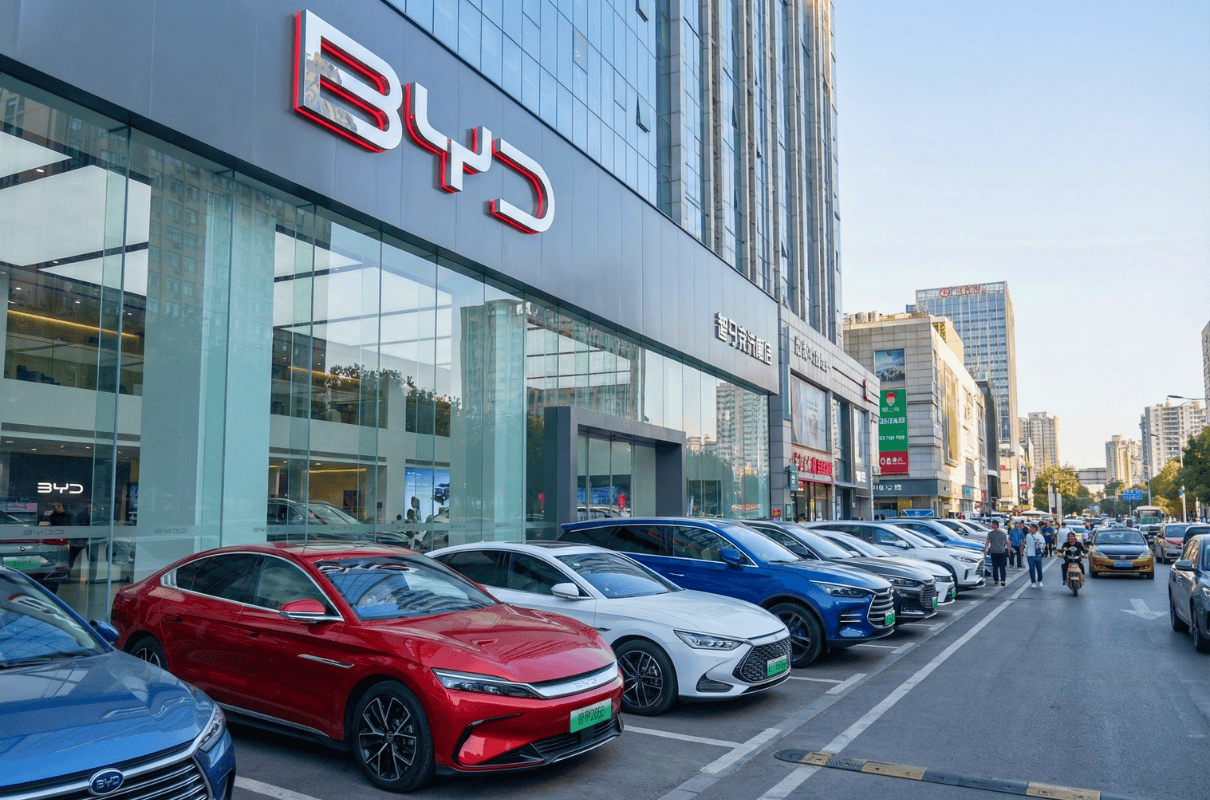

The balance of power in the electric-vehicle world is changing — and faster than many believed possible. China’s BYD, once seen as little more than a budget competitor, is now on the brink of overtaking Tesla to become the world’s leading electric-car producer. But the story is not as straightforward as a race for volume. It’s a story about bruising price wars, obsolescent technological moats, and a domestic market as brutal as it is enormous.
BYD finished 2025 with its battery-electric-vehicle sales topping 2.25 million, and at just over 4.5 million total vehicles delivered when hybrids are included in your tally. That would put the Shenzhen-based automaker within striking distance — and, by some tallies, ahead — of Tesla’s global total, which analysts expect to end at about 1.6 million this year.
In other words, Tesla is no longer the lone king of the mountain.
Growth slows — but leadership holds
The headline might seem to contradict: BYD reigned even as growth slowed. The firm saw its weakest growth in five years, with total sales likely slowing to “7–8% in 2025”. December was particularly painful, with deliveries falling for the fourth straight month as home-market demand weakened and rivals slashed prices without mercy.
But even with that slowdown, BYD still loomed over its rivals in pure volume. Those broad and disparate lines up, from cheap urban EVs to PHEV crossovers, helped maintain momentum in a time of struggle for the legacy marques.
The price war that changed the game
China’s EV industry in 2025 felt more like trench warfare than good sportsmanship. Manufacturers launched wave after wave of discounts. BYD itself slashed prices on more than 20 models, sparking a selloff in auto shares and a stern warning from industry veterans that the market was moving into “unhealthy” territory.
Consumers benefited. Margins did not.
Meanwhile, startups seized the moment. Leapmotor, Xpeng, and Xiaomi surfed the budget-EV wave with aggressive pricing and rapid production ramp-ups. Leapmotor nearly doubled sales year-on-year. Xpeng’s Mona series fuels a late-year surge. Even newcomers such as Xiaomi posted their highest monthly totals.
Premium-leaning brands? Not so lucky. Li Auto’s deliveries sank significantly from a 2024 peak before beginning to reverse course in December.
BYD’s technological edge comes under scrutiny
A second storyline sprouted in 2025: BYD’s once-vaunted technological lead began to slip away.
Chairman Wang Chuanfu conceded as much, citing growing competition and hinting at “major innovations” in the works for 2026. The company added fast-charging technology and driver-assistance capabilities. Still, they were not enough to entirely arrest share erosion in China’s most price-sensitive segments.
But the strategic flexibility of BYD paid off. It merely turned its gaze outward when domestic demand cooled.
Overseas expansion gathers momentum
As local demand has slowed, the overseas news from BYD has been the opposite — emphatically expansionist. Shipments outside China soared past the 1-million-unit mark, with Europe, Latin America and Southeast Asia serving as growth pillars. The company has said it hopes to ramp up overseas sales further by 2026, suggesting its global ambitions are only getting started.
Tariffs and geopolitical scrutiny have not slowed down the march. In countries such as the UK, BYD’s sales soared, especially of plug-in hybrid SUVs aimed squarely at budget-minded families.
Tesla faces a very different crossroads
Tesla, by contrast, enters 2026 from a fundamentally different strategic vantage point.
Instead of doubling down on an affordable $25,000 electric vehicle — a car once sold as the company’s next mass-market saviour — Elon Musk has pivoted to artificial intelligence, robotaxis and humanoid robotics. The bet is massive. If autonomy scales as Musk predicts, Tesla becomes a tech platform that happens to make cars, not the other way around.
But that pivot comes as competition heats up and some consumers recoil from political controversies involving Musk himself. Tesla has started offering cheaper versions to spur demand in the United States. However, analysts are still predicting year-over-year declines in deliveries.
What the new EV battleground really looks like
In short, 2025 blew up the EV playbook.
• Budget models beat luxury nameplates
• Price cuts became weapons
• Startups grew faster than incumbents
• China’s domestic market dictated global momentum
• Overseas expansion became BYD’s pressure valve
BYD’s year wasn’t perfect — slower growth, intense competition and thinner margins “circumscribed” the company — but it was historic. It showed that on a global scale, not just a prismatic one, size matters when it comes to the next chapter of electrification across the world.
Tesla remains the leader in brand magnetism and software capability. But for the first time since the modern era of EVs, it has left it with a rival that matches — and in some dimensions exceeds — its output.
Now that rivalry is less of an abstraction. Now it is the main storyline of the global automotive industry.
For more information & News related to BYD, please visit their official News website.
👉 Please 📩SUBSCRIBE to us for more real-world EV analysis, news, and deep dives — written for EV fans by EV fans.

Hey, I’m Badal! I’m super passionate about cars—especially electric ones. Whether it’s EVs, electric trucks, bikes, or anything with a battery and wheels, I’m all in. I love writing blogs and articles that break things down for fellow enthusiasts and curious readers alike. Hope you enjoy the ride as much as I do! Enjoyed reading? You can buy me a coffee on PayPal ☕ → paypal.me/BadalBanjare



[…] loss of the No. 1 spot wasn’t all about BYD’s growth. Tesla itself stepped […]
Respect to article author, some great selective information.