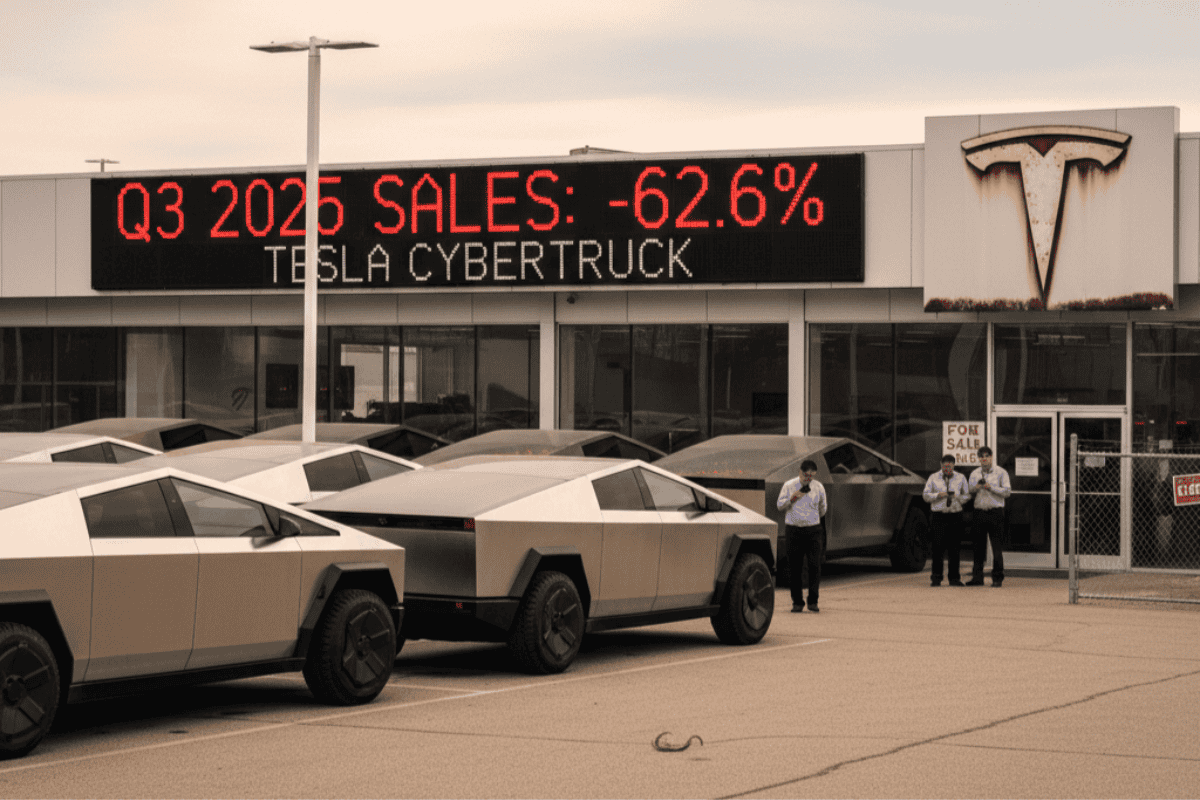

Tesla’s stainless-steel spectacle, the Cybertruck, is quickly becoming less of the shiny figurehead that it was already labeled as for automotive futurism. Once vaunted as Elon Musk’s most ambitious invention yet, the truck that was supposed to revolutionize the American pickup is instead under siege — with sales in free fall and demand sputtering.
Cox Automotive and Kelley Blue Book numbers show that the company only managed to move 5,835 Cybertrucks in Q3 2025, down more than 62.6 percent from the same quarter last year. That’s a decline of over 14,000 units delivered during the same period last year. To add insult to injury, Tesla smashed a meek 16,000 Cybertrucks for the year 2025 overall and was nowhere near the glory of Musk’s expectation of selling 250,000 trucks every year.
Even more remarkable is that the rest of the electric-vehicle market is still on a tear. The U.S. electric vehicle market had its best quarter ever, with more than 438,000 EVs sold — up nearly 30 percent from this time last year. Buyers rushed to take advantage of federal EV tax credits before they expired in September, a wave Tesla was unable to ride despite its well-known brand.
Rival carmakers, meanwhile, are grabbing the attention. Ford’s F-150 Lightning came in at nearly twice the sales of Cybertruck, while Rivian’s R1T and Chevrolet’s Silverado EV made substantial gains. Even GMC’s Hummer EV surged almost 22% and Sierra EV deliveries soared 771% higher — all of which suggests fierce competition within the electric pickup market is getting white hot.
There is a deeper story in the numbers if you look inside. Tesla no longer breaks out figures for the Cybertruck; they’re now grouped in an “other models” category with the aging Model S and X, a strange decision for a product that was once pitched as game-changing. Analysts think the company is trying to conceal the truck’s disappointing path at a time that overall demand for the Model Y and its older cousin, the Model 3, continues to buoy Tesla’s quarterly results.
Compounding Tesla’s woes, the Cybertruck has made more headlines lately, ones in which it is not necessarily breaking sales records. It included a string of lawsuits that identified malfunctioning door handles as the reason that occupants could not escape after a fatal crash. And in an unusual development, reports suggest Musk’s private companies, including SpaceX and xAI, are buying the unsold Cybertrucks to replace their own internal combustion-powered vehicles as part of their company fleets. And while that may help move old inventory, it doesn’t exactly paint a pleasant picture of Tesla’s flagship vehicle being unable to find real buyers.
When Musk revealed the Cybertruck in 2019, its $39,990 starting price, Blade Runner aesthetic, and millions of preorders soon turned it into a cultural phenomenon. But six years later, as prices have begun above $60,000, many early fans are finding that its Jetsons design doesn’t necessarily translate to practical reality.
While Tesla retains over 40% of the U.S. EV market, its dominance is eroding — that share was closer to 50% a year ago. Instead of Tesla’s next big thing, the Cybertruck has become a reminder of how swiftly innovation can become overreach.
Yet for a company built on bold promises, the Cybertruck’s stumble is also a bracing reminder: As it turns out, disruption is easy to dream, and quite difficult to sustain.
For more information about the Tesla Cybertruck, visit their official website.
👉 Please 📩SUBSCRIBE to us for more real-world EV analysis, news, and deep dives — written for EV fans by EV fans.

Hey, I’m Badal! I’m super passionate about cars—especially electric ones. Whether it’s EVs, electric trucks, bikes, or anything with a battery and wheels, I’m all in. I love writing blogs and articles that break things down for fellow enthusiasts and curious readers alike. Hope you enjoy the ride as much as I do! Enjoyed reading? You can buy me a coffee on PayPal ☕ → paypal.me/BadalBanjare