
Ferrari has finally crossed the electric threshold, not with a whisper, but with intent.
The company’s first all-electric sports car is officially called Ferrari Luce, and with that name comes a carefully choreographed message: this isn’t just an EV with a prancing horse badge. It’s a philosophical reset. A statement about how Ferrari believes performance, emotion, and craftsmanship should evolve in an electric age.
While the exterior remains under wraps until May, Ferrari has now revealed the Luce’s interior—and it’s already redefining expectations.

A Historic Step, Taken Carefully
Ferrari’s entry into electrification arrives at a complicated moment. Global EV demand has cooled in some luxury segments. Regulators are quietly softening earlier zero-emissions timelines. Meanwhile, high-performance combustion cars are enjoying a renewed surge in popularity.
Against that backdrop, launching an electric Ferrari feels bold. Maybe even defiant.
But Ferrari isn’t positioning the Luce as a replacement for its V12S or turbocharged icons. It’s something parallel. Something new. CEO Benedetto Vigna has described it as a project meant to “illuminate the road ahead,” which explains why the brand moved away from the blunt internal name Elettrica in favour of Luce, Italian for light.
The implication is clear: this car isn’t defined by what it lacks, but by what it introduces.
Designed by the Minds Behind Apple
To shape that future, Ferrari turned to LoveFrom, the San Francisco–based creative collective founded by Sir Jony Ive and Marc Newson. It’s the first time Ferrari has collaborated with an external studio across an entire vehicle design.
The pedigree is unmistakable. I’ve spent nearly three decades shaping Apple’s visual and tactile language, while Newson’s work spans aviation, furniture, cameras, and architecture. Together, they bring a design philosophy rooted in restraint, material honesty, and obsessive attention to detail.
That influence is immediately visible inside the Luce.
Flat glass surfaces. Softly radiused edges. Precision-machined aluminum. A cabin that feels calm rather than theatrical—yet unmistakably premium. Some have already likened it to an “Apple-designed Ferrari,” and the comparison isn’t entirely wrong. But this isn’t consumer electronics cosplay. It’s something more deliberate.
A Cabin Built Around Driving, Not Screens
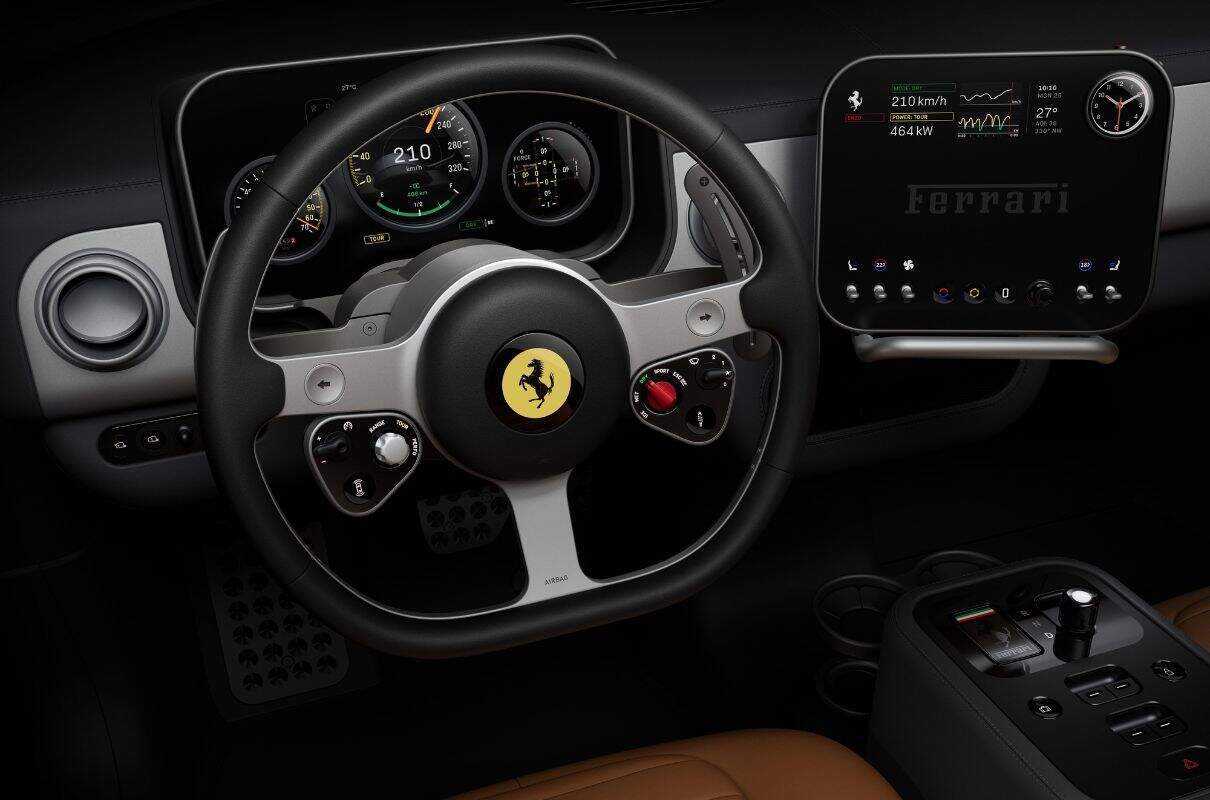
At first glance, the interior looks deceptively simple. A three-spoke steering wheel. A clean instrument binnacle. A compact central display. Four sculpted air vents are set into an aluminium structure.
But simplicity, as Ferrari and LoveFrom are eager to point out, is brutally difficult to achieve.

The steering wheel is the focal point. It’s a modern reinterpretation of classic Ferrari wheels from the 1950s and ’60s, machined from 100 percent recycled aluminium and featuring Ferrari’s familiar manettino, paddles, and controls. Every button has been tuned for mechanical feel and acoustic feedback, tested repeatedly by Ferrari’s development drivers.
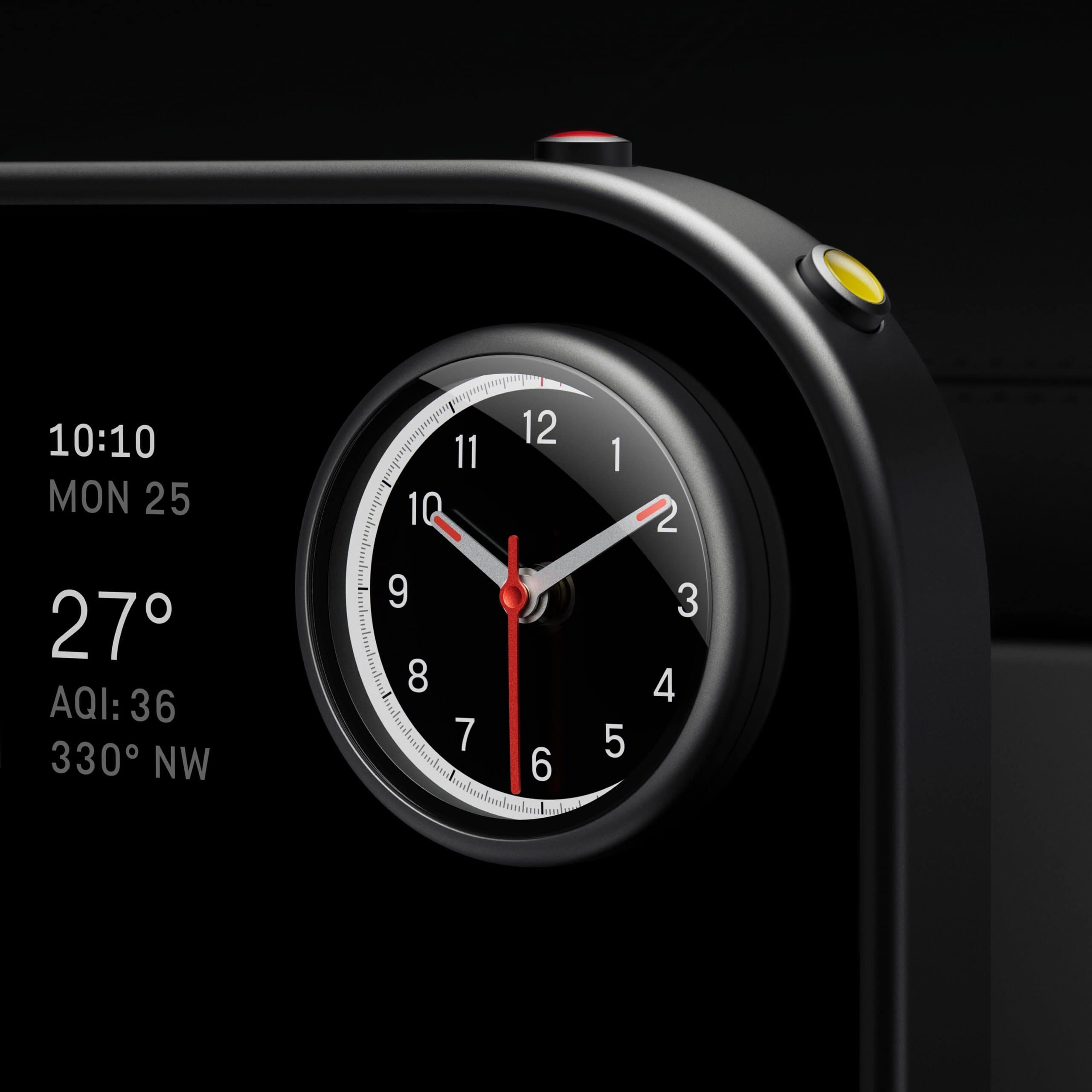
Behind it sits a digital instrument cluster inspired by vintage aviation watches and historic Ferrari dials. OLED displays supplied by Samsung sit beneath convex lenses, creating a subtle parallax effect as viewing angles change. Physical needles float against deep-black screens when the car is off, then illuminate dramatically at startup.
Ferrari claims this approach reduces cognitive load. Fewer distractions. Clearer information. Less “smartphone on wheels.”
A Screen That Knows Its Place
The central infotainment screen tells a similar story. It’s modest in size by modern standards and mounted on a ball-and-socket joint, allowing it to swivel toward either the driver or passenger. If the driver doesn’t want to see it at all, it can be angled out of view.
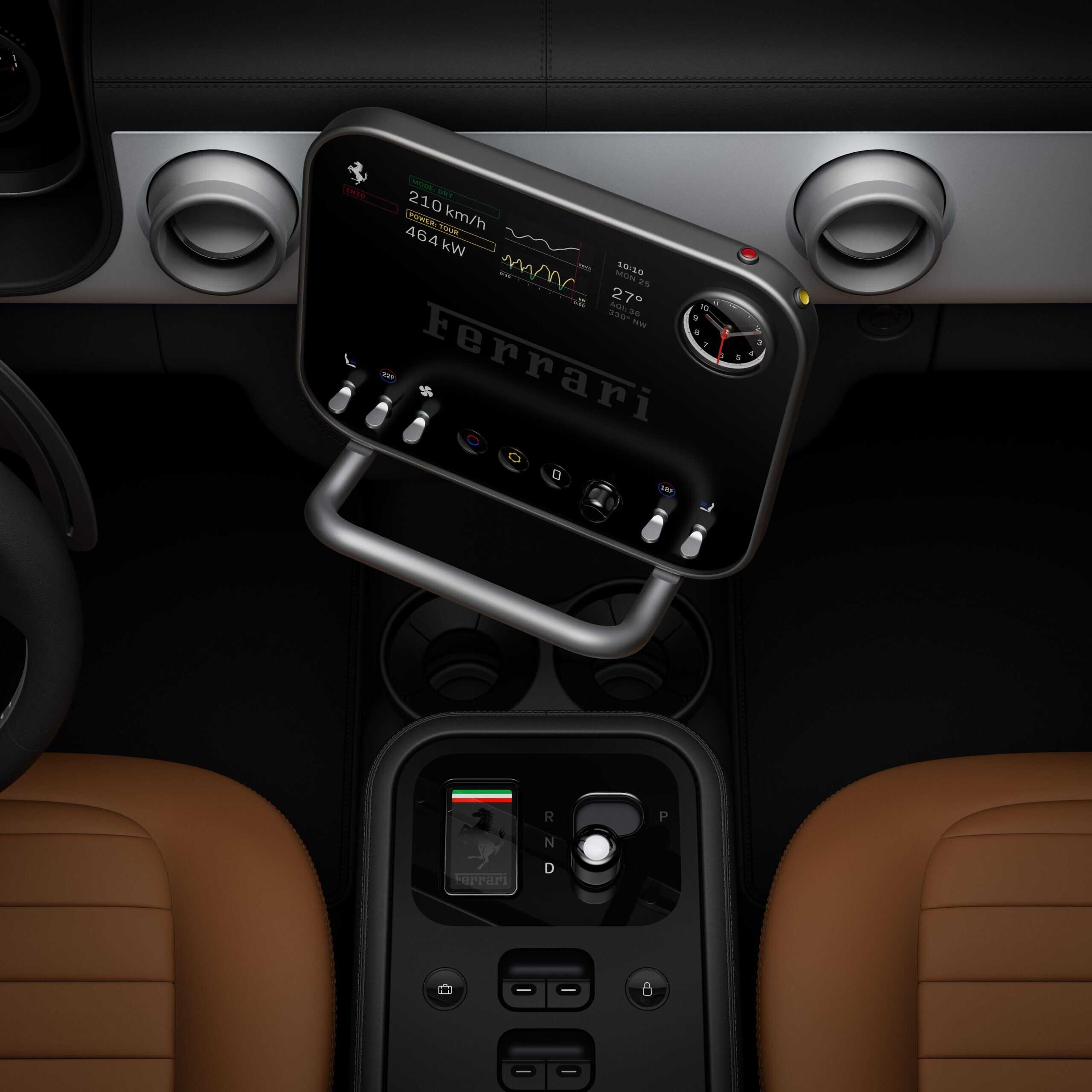
A palm rest beneath the display makes interaction more precise. At the same time, physical toggle switches remain for key functions, such as climate control. The message is consistent: touchscreens are useful, but they shouldn’t dominate the driving experience.
Overhead, additional controls—including launch functions—sit near the rear-view mirror, borrowing cues from aviation rather than smartphones.
Glass, Aluminium, and Zero Shortcuts
Material choice inside the Luce is intentionally restrained. Aluminum. Glass. Leather. Plastic appears only where absolutely unavoidable.

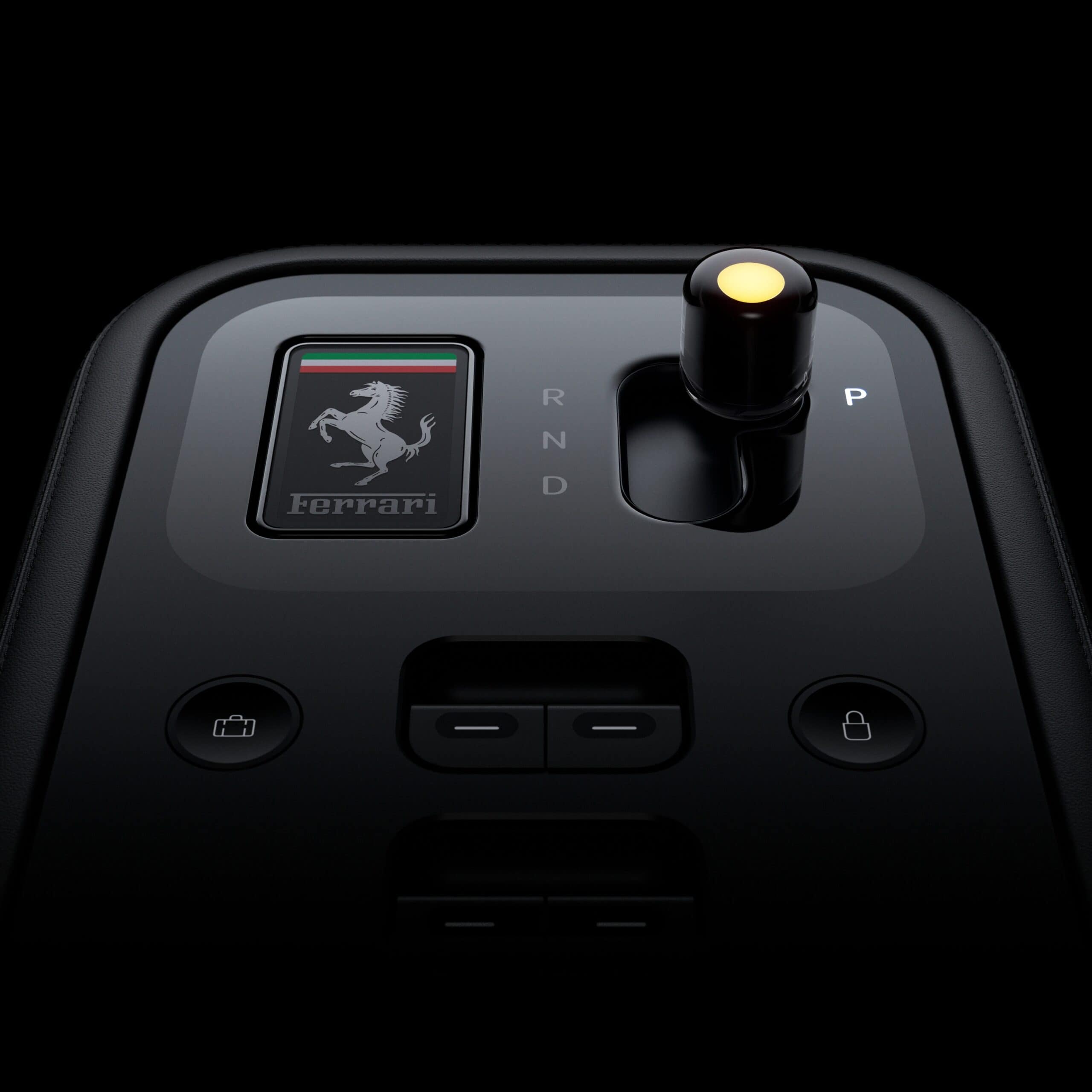
More than 40 glass components are used throughout the cabin, developed in partnership with Corning. The centrepiece is the glass gear selector, crafted from Corning’s Fusion5 glass and etched with thousands of microscopic laser-drilled holes to evenly diffuse light. Scratch resistance exceeds conventional automotive glass, ensuring it retains its jewel-like finish over time.

The key fob is equally theatrical. Glass-backed. Ferrari yellow. Slot it into the centre console, and its e-ink surface fades from yellow to black as the cabin awakens. Displays glow. Controls illuminate. The car feels alive before it even moves.
Excessive? Perhaps. But excess, when executed with purpose, has always been part of Ferrari’s DNA.
Performance Without Pretending
Ferrari has already confirmed key hardware details. The Luce will use a dual-motor setup producing over 736 kW, sprint from 0–100 km/h in under 2.5 seconds, and draw energy from a 122 kWh in-house battery pack. Expected range exceeds 530 kilometres.
Sound, too, has been reimagined. Rather than simulating combustion noise, Ferrari has engineered a bespoke acoustic system that amplifies authentic powertrain vibrations, creating a soundscape that feels inherently electric—and unmistakably Ferrari.
The goal isn’t imitation. Its identity.
More Than an Electric Ferrari
Ferrari insists the Luce is not a one-off experiment. The company has hinted that it marks the beginning of a new naming philosophy and design language, though details remain closely guarded.
What’s clear is this: Ferrari isn’t chasing trends. It’s attempting to redefine what an electric performance car should feel like, prioritising emotion, tactility, and restraint over spectacle.
The exterior reveal arrives in May. Production will follow at Ferrari’s Maranello e-building. And soon after, an electric Ferrari will be driving on public roads—a sentence that still feels surreal.
But if the care poured into the Luce’s interior is any indication, Ferrari isn’t abandoning its soul. It’s recalibrating it.
Quietly. Precisely. On its own terms.
For more information about the Ferrai Luce, please visit their official website.
👉 Please 📩SUBSCRIBE to us for more real-world EV analysis, news, and deep dives — written for EV fans by EV fans.

Hey, I’m Badal! I’m super passionate about cars—especially electric ones. Whether it’s EVs, electric trucks, bikes, or anything with a battery and wheels, I’m all in. I love writing blogs and articles that break things down for fellow enthusiasts and curious readers alike. Hope you enjoy the ride as much as I do! Enjoyed reading? You can buy me a coffee on PayPal ☕ → paypal.me/BadalBanjare