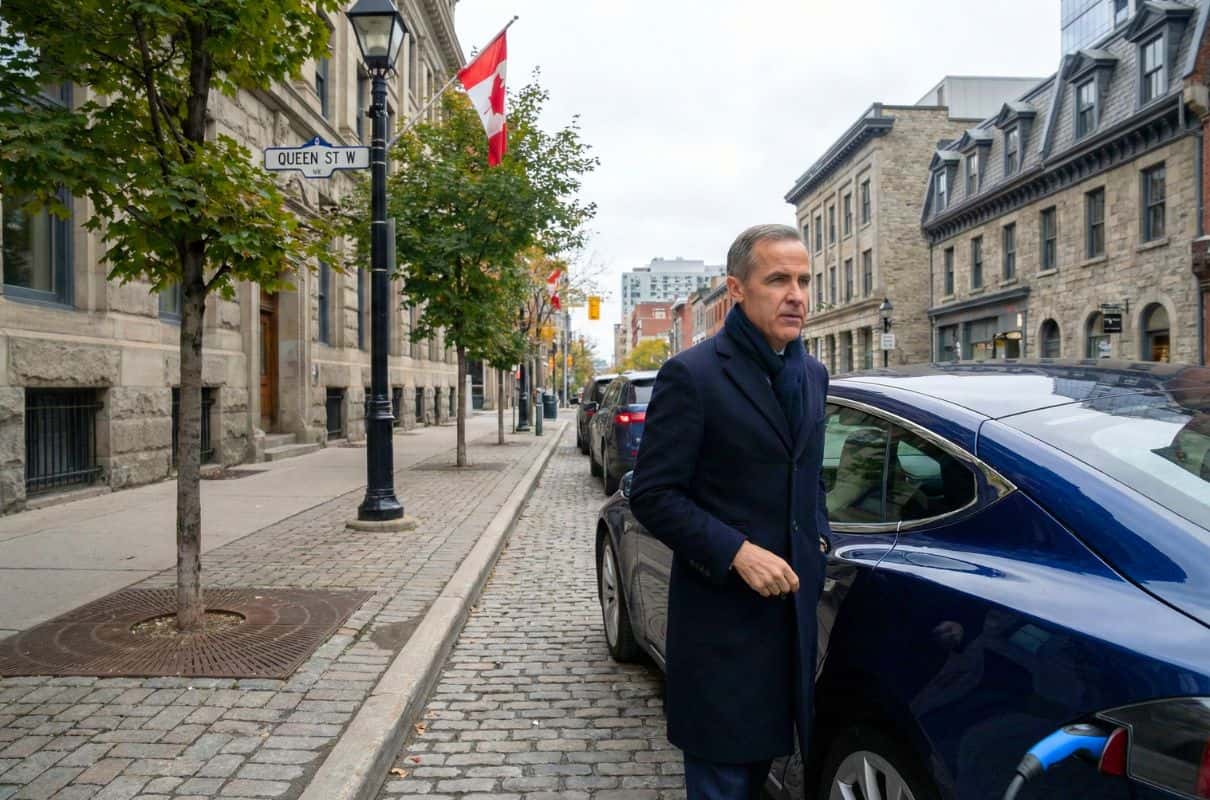

Canada’s electric vehicle strategy is about to get a hard reboot — and the stakes could scarcely be higher.
Confronting trade uncertainty, rising emissions, and an auto sector heavily levered to the U.S. market, Prime Minister Mark Carney has rolled out a massive rewrite of federal auto policy. The move, headlined there, is bold: The government plans to scrap its national EV sales mandate in favour of a smattering of financial incentives, tighter emissions rules, and a major investment push in domestic manufacturing.
Carney refers to it as a results-first method. Critics aren’t so sure.
A New Roadmap for a Vulnerable Industry
The auto industry in Canada is particularly vulnerable. More than 90 percent of automobiles assembled domestically — and a majority of the parts used to make vehicles — are sent south of the border. As global trade patterns crumble and U.S. industrial policy turns more inward, that dependency has become increasingly risky.
The government’s solution is an industrial strategy that aims to diversify markets, secure domestic production, and reposition Canada as a significant player on the global EV stage.
The centrepiece of that plan is money. Alongside up to $100 million in regional assistance, Ottawa is earmarking $3 billion from its Strategic Response Fund to help automakers retool plants and expand production lines while creating new export markets. Manufacturers of clean-tech products will be able to take advantage of quicker write-offs for tax purposes and lower corporate tax rates, both aimed at boosting the production of zero-emission vehicles.
The message is clear: build in Canada or get left behind.

Mandate Out, Emissions Standards In
Among the most contentious issues is removing a federal mandate requiring automakers to sell electric or plug-in hybrid passenger vehicles for all models by 2035.
In their place, the government is proposing a tougher set of tailpipe emissions standards. Officials say the new rules will drive EV adoption to 75 percent of new vehicle sales by 2035, rising to 90 percent by 2040 — all without requiring automakers to meet prescriptive sales quotas.
Carney says the new framework provides manufacturers with flexibility while still achieving deep cuts in emissions. The rules, which rely on grams-per-mile standards, are projected to cut carbon pollution from cars and trucks by over 50 percent when fully in place.
But key details remain unfinished. Federal officials concede that final modelling is ongoing as well, and the regulations are expected to be released later this year. It’s that uncertainty that has become a flash point for critics.
Incentives Return, With Strings Attached
To boost demand, Ottawa is reinstating consumer EV incentives with a five-year, $2.3 billion affordability program.
Under the plan, buyers can come back up to $5,000 for battery-electric and hydrogen fuel-cell vehicles, and up to $2,500 for plug-in hybrids — so long as it doesn’t cost more than $50,000 to purchase and is manufactured in a country with a free trade agreement with Canada. Canadian-made electric vehicles and PHEVs are excluded from the price cap, which is also a pretty direct wink to domestic manufacturers.
The feds are also spending $1.5 billion to build new charging and hydrogen refuelling stations across the country, aiming to address one of the largest psychological roadblocks to widespread electric vehicle use: fear of running dry or out of juice and being stuck on the side of the road.
Climate Credentials Under Scrutiny
Transportation is still one of Canada’s biggest and fastest-growing sources of greenhouse gas emissions. For climate scientists, it’s what makes the policy pivot so risky.
Some experts say that removing the sales mandate would give automakers back the leverage (many of which lobbied against it) and could slow electrification if emissions standards are relaxed under industry pressure.
The concerns are heightened by a broader pullback from previous climate actions. Carney has scrapped the consumer carbon tax, watered down commitments to cap oil and gas emissions, and signalled openness to new fossil fuel infrastructure.
The pattern has been picked up by opposition parties, who have accused the government of watering down Canada’s climate leadership. Carney rejects that framework, arguing the focus is on measurable results, job creation and achievable paths to lower emissions.
Trade, China and the global EV chessboard
It’s also emblematic of a realignment in Canada’s trade stance.
Ottawa is holding onto its retaliatory tariffs on American autos and bolstering its automotive remission scheme to favour firms that build cars in Canada. Yet Canada is, at the same time, casting its international net more widely.
A new memorandum of understanding with South Korea strengthens the partnership for future mobility. On a more controversial front, however, Canada has formed a strategic EV alliance with China, enabling a capped number of Chinese-made EVs into the Canadian market while spurring joint ventures and battery-sector investment in Canada.
The move reflects Beijing’s own aggressive effort to ramp up battery production as its clean energy transition gains momentum — and suggests Ottawa is willing to take steps to diversify supply chains, even amid geopolitical conflict.
Workers Caught in the Middle
To soften the blow, the government is introducing a package of labour initiatives that includes a new work-sharing grant to avoid layoffs and $570 million in retraining and job support for up to 66,000 workers. A national alliance of the workforce will seek to match training with industry and private investment.
And an admission that the EV shift isn’t just a technological one — it’s about people.
A High-Stakes Gamble
Carney’s approach to cars is ambitious, complex and politically fraught. Supporters view them as a pragmatic approach to balancing climate goals with industrial realities. Skeptics regard it as a retreat with the accoutrements of reform.
Whether tighter emissions rules, coupled with a reborn incentive fund, can accomplish the electric surge Ottawa is promising — provided it hasn’t already come this year without the need for a national decree — without the binding mandate remains an open question.
What is clear, however, is that the decisions made now will determine what Canada’s automotive sector looks like for the next several decades. And once this road is taken, there may be no simple U-turn.
For more information about PM Mark Carney’s EV strategy for Canada, please visit here.
👉 Please 📩SUBSCRIBE to us for more real-world EV analysis, news, and deep dives — written for EV fans by EV fans.

Hey, I’m Badal! I’m super passionate about cars—especially electric ones. Whether it’s EVs, electric trucks, bikes, or anything with a battery and wheels, I’m all in. I love writing blogs and articles that break things down for fellow enthusiasts and curious readers alike. Hope you enjoy the ride as much as I do! Enjoyed reading? You can buy me a coffee on PayPal ☕ → paypal.me/BadalBanjare