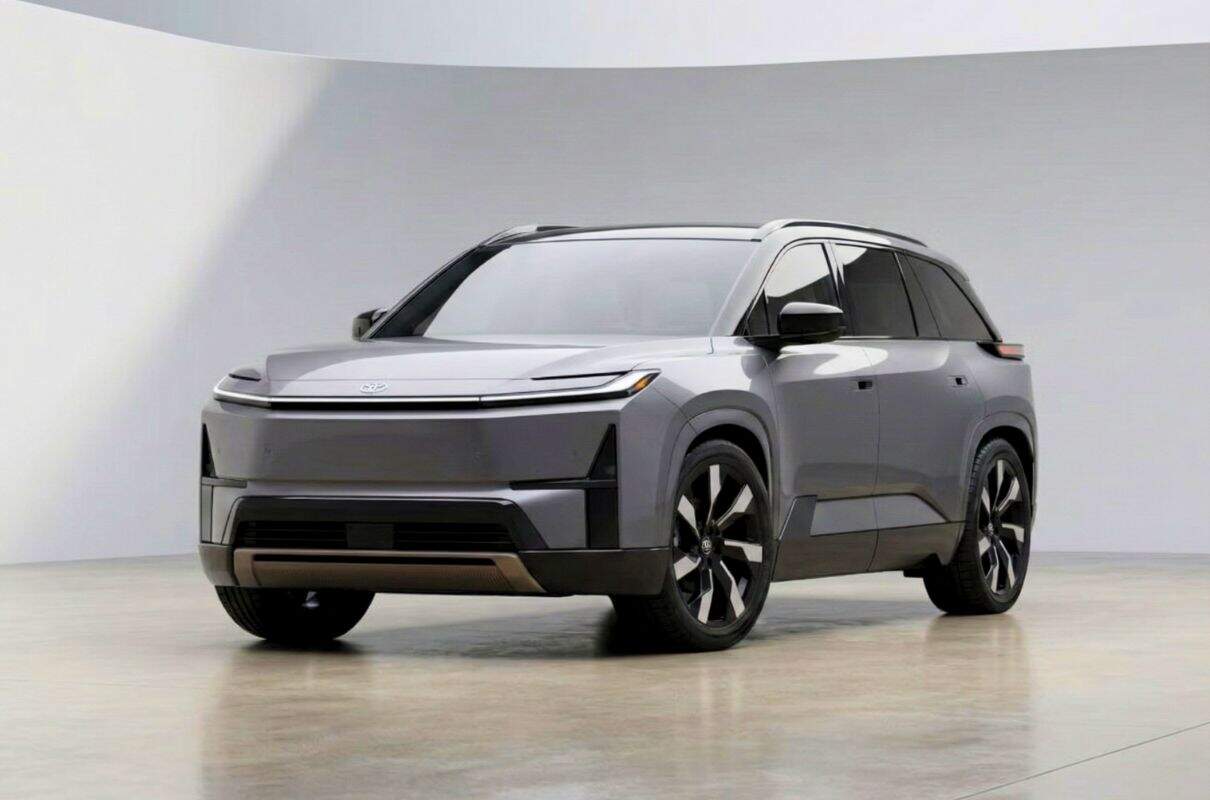

For months now, the Kia EV9 has owned that spotlight, enjoying a rare bit of low-competition dominance. That changes now. Toyota has taken the wraps off its first fully electric three-row SUV, which will go on sale in 2028, showing that the automaker is done dabbling, and that’s refreshing. It’s a tactic: a full-throated play into one of the fastest-growing EV segments in America.
This is not only an electric version of a familiar family hauler. It is a strategic reset for one of Toyota’s most visible nameplates.
Toyota’s First Three-Row EV Arrives With Up to 320 Miles of Range
The 2027 Highlander EV will be available in two battery variants:
- 77 kWh battery
- 95.8 kWh extended-range battery
Toyota expects a driving range of 270 to 320 miles, depending on the drivetrain and battery choice. The most efficient version, the XLE front-wheel-drive, is expected to achieve about 287 miles per charge. Move up to the larger battery with all-wheel drive, and the Range jumps to a competitive 320 miles.

That leaves it going head-to-head with the Kia EV9 and Hyundai IONIQ 9, two companies that’ve barely even started waving the checkered flag in this space.
EPA certification is not due until later, but on paper at least, Toyota’s figures suggest a focus on efficiency rather than muscle in its battery size.
Powertrain Options: FWD Efficiency or AWD Muscle
Buyers can choose between two performance characters.
The Highlander EV comes with front-wheel drive and a single motor that produces 221 horsepower and 198 lb-ft of torque. It was designed for well-balanced daily use — smooth acceleration, quiet operation, and commuter-friendly efficiency.
Choose the dual-motor setup, and output increases to 338 horsepower and 323 pound-feet of torque. The AWD version should deliver quite a bit more acceleration and highway confidence.

Toyota has yet to publish official 0–60 times. Still, the numbers should make the AWD model feel markedly quicker than the former gasoline- or hybrid-powered Highlanders.
Drivers encountering snow, gravel, or uneven terrain are also rewarded in AWD models with Multi-Terrain Select and Crawl Control, which expand the SUV’s capability beyond suburban pavement.
Built in America, Backed by a Massive Battery Investment
Underlining its commitment to growing the EV market in this country, Toyota announced that the 2027 Highlander EV will be built at its factory in Georgetown, Kentucky; it’s the first Toyota-branded EV set to wear a label reading “MADE IN U.S.A.”
The battery packs will be sourced from Toyota’s recently announced $13.9 billion battery plant in Liberty, North Carolina — a lynchpin in the automaker’s push to electrify its North American offerings.
The signal is clear: Toyota is going to start making EVs in the U.S. aggressively and with a laser-like focus on taking market share, perhaps over 10% of the U.S. EV market being its objective, within roughly four years from now.
A Larger Footprint With a Longer Wheelbase
The electric Highlander is built on a modified version of Toyota’s TNGA-K platform, revised to accommodate the required battery packaging and make the most of interior space.
Key dimensions include:
- Length: 198.8 inches
- Width: 78.3 inches
- Height: 67.3 inches
- Wheelbase: 120.1 inches
That wheelbase stretch — up from 112 inches before equals more cabin space, especially for second-row occupants.
It’s still a bit smaller than the Grand Highlander, but it’s certainly larger than the gas model it will replace.
Design: The “Hammerhead” Era Continues
The Highlander EV wears Toyota’s updated “hammerhead” look — thin LED daytime running lights, a semi-sealed cunt, and an aerodynamically styled front.
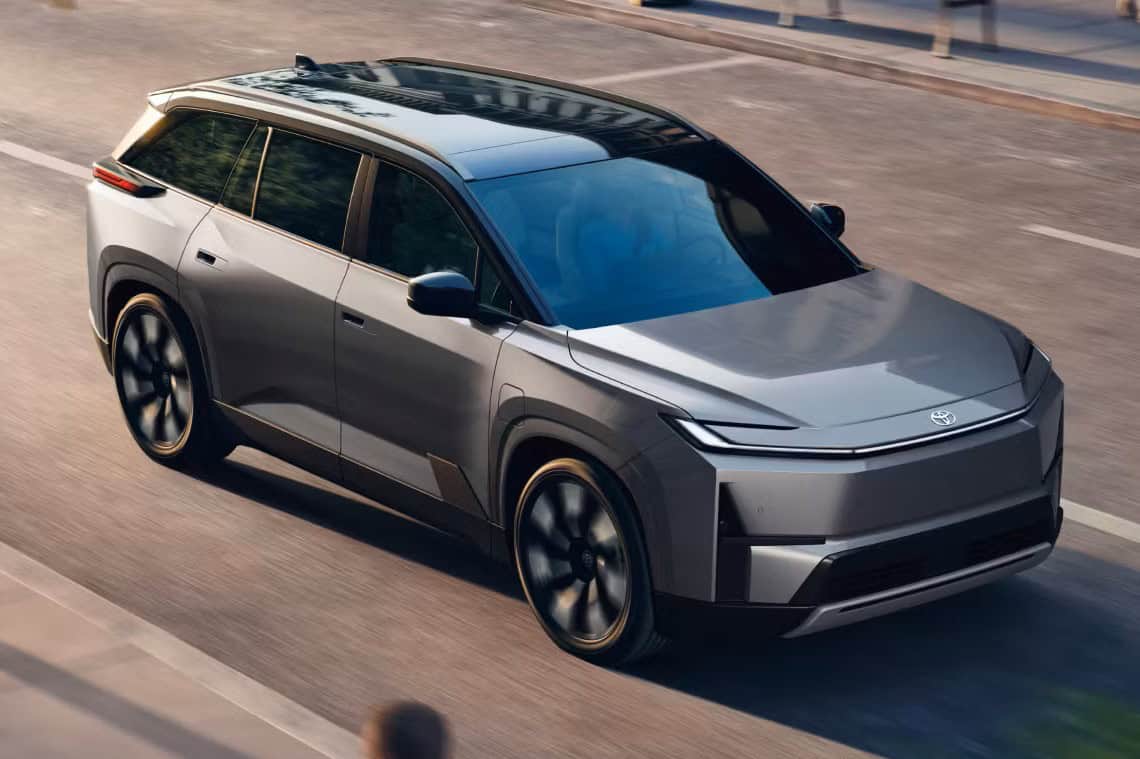
It’s also less traditionally conservative-looking than previous Highlanders. More assertive. More contemporary. And unmistakably electric.
Interior: Tech-Forward Without Abandoning Practicality
Inside, Toyota marries digital sophistication with ergonomic common sense.
A 12.3-inch digital dashboard lives behind the steering wheel, complemented by a large 14-inch touchscreen interface featuring the latest Toyota multimedia system. Standard features include wireless Apple CarPlay and Android Auto.

Crucially, the physical climate controls stay — a move that owners will no doubt silently applaud.
Seating is available in SofTex faux leather, and customizable color themes are available for the ambient lighting. Second-row captain’s chairs are standard in most configurations (a bench seat is available on the XLE for seven-passenger capacity).
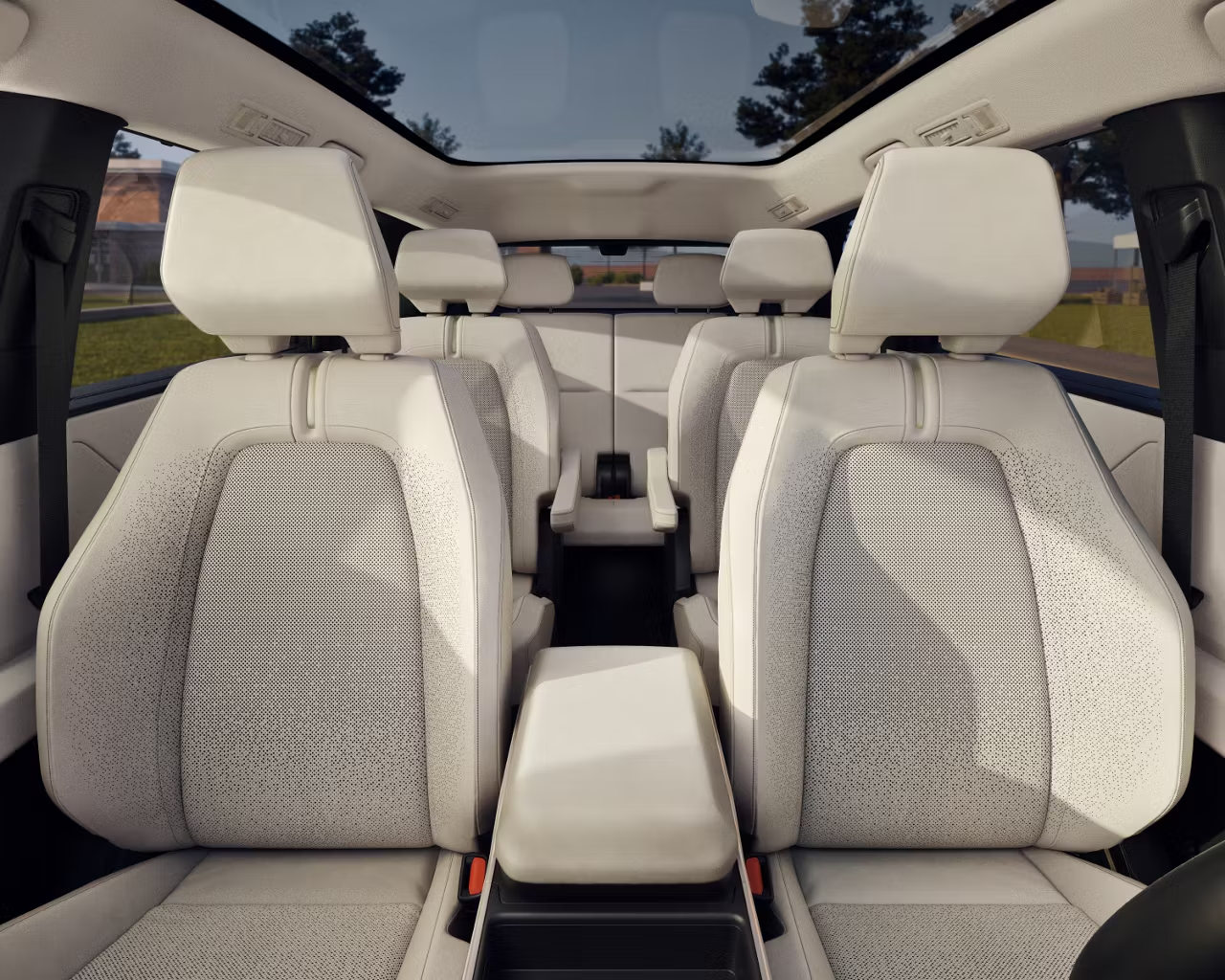
Fold down the third row to get more than 45 cubic feet of cargo space. There is no front trunk, but Toyota makes up for lost cargo space with clever stowage solutions throughout the cabin — including a multi-function center console and a freaking-strange-but-nifty 18-cup holder.
A panoramic glass roof — Toyota’s largest ever — is available, and a head-up display is available on pricier trims.
Charging: Tesla Supercharger Access Included
One of Highlander EV’s most advanced features is its North American Charging Standard (NACS) port.
In other words, direct access to Tesla’s vast Supercharger network without adapters.
Under ideal conditions, Toyota estimates that 10% to 80% of the battery can be charged in about half an hour. It’s a few minutes behind Kia EV9’s projected 24-minute charge time, but it’s competitive for road-trip usefulness.

The SUV also supports:
- Battery preconditioning
- Plug & Charge functionality
- Cold-weather charging optimization
A Surprise Feature: Vehicle-to-Load (V2L)
Making its Toyota debut, the Highlander EV introduces Vehicle-to-Load technology.
Owners can charge appliances, tools, or outdoor gear right through the vehicle. It’s a temporary source of electricity in an emergency.
From tailgates to power outages, the Highlander is not just transportation but a portable energy supply.
Highlander EV vs. Kia EV9: Early Spec Comparison
The battle lines are clear.
- Base power: Highlander EV (221 hp) edges out base EV9 models.
- Dual-motor performance: EV9 counters with higher peak horsepower (up to 379 hp).
- Range: Highlander leads with up to 320 miles versus EV9’s 305-mile maximum in comparable trims.
- Charging speed: EV9 holds a slight advantage.
Toyota prioritizes efficiency and universal usability. The Kia is the one that also pushes harder for outright performance and, in particular, faster charging.
Pricing and Market Position
Final pricing hasn’t been announced by Toyota, but estimates peg it at around $50,000, just below the Kia EV9’s $54,900 base MSRP.
If it sticks with those prices, the Highlander EV could undercut some critical competitors while delivering similar — or even longer — Range.
Sales are expected to start later this year, with showroom deliveries forecast to begin in late 2026.
The Bigger Picture
The 2027 Toyota Highlander EV adds to Toyota’s growing lineup of electric SUVs, which includes the C-HR and the new bZ and bZ Woodland. For a company that had once been derided for moving too slowly in electric vehicles, this launch represents a clear step on the gas.
A familiar nameplate. A radically different propulsion system.
And a stretch that suddenly seems far more competitive.
The theoretical three-row electric SUV race is now over. It’s already happening — and Toyota just made it more intriguing.
For more information about the 2027 Toyota Highlander EV, please visit their official website.
👉 Please 📩SUBSCRIBE to us for more real-world EV analysis, news, and deep dives — written for EV fans by EV fans.

Hey, I’m Badal! I’m super passionate about cars—especially electric ones. Whether it’s EVs, electric trucks, bikes, or anything with a battery and wheels, I’m all in. I love writing blogs and articles that break things down for fellow enthusiasts and curious readers alike. Hope you enjoy the ride as much as I do! Enjoyed reading? You can buy me a coffee on PayPal ☕ → paypal.me/BadalBanjare